
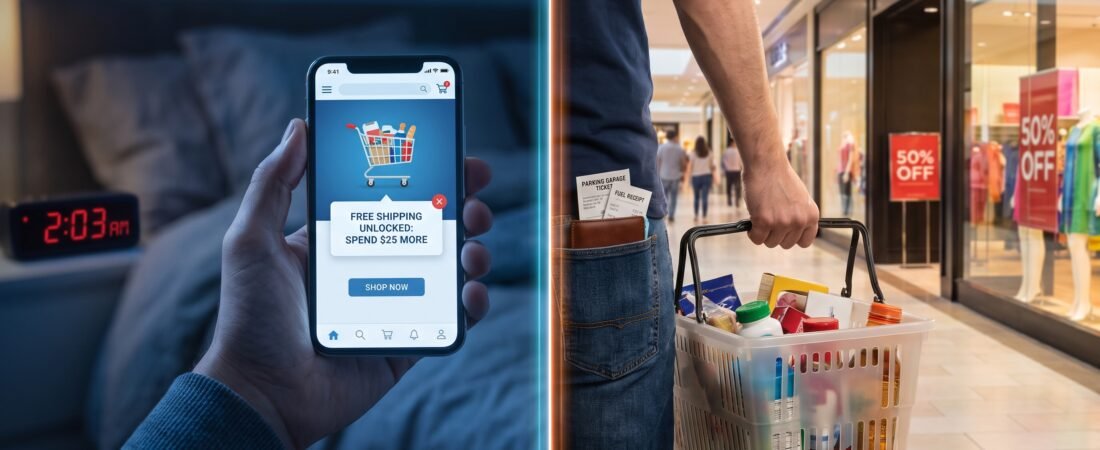
At first glance, Online Shopping vs. Offline Shopping can seem like an easy way to save money: no drive to the store, instant price comparisons, and discount codes at your fingertips. But shipping fees, membership costs, return policies, and impulse purchases can change the final price. In this first part of our Online Shopping vs. Offline Shopping comparison guide, we break down common hidden costs and show you how to think about the total cost of each option before you buy.
The Comparison at a Glance
- Online Shopping Trap: Convenience can make impulse purchases, subscription fees, shipping charges, and return costs easier to overlook.
- Offline Shopping Trap: Transportation, parking, time, and differences in store pricing can increase the total cost.
- The Smarter Strategy: Compare the full cost—not just the listed price—and choose the option that best fits the purchase.
In This Guide
Online Shopping vs. Offline Shopping Cost Matrix
| Cost Factor | Online Shopping | Offline Retail Shopping | Better Option |
|---|---|---|---|
|
Price Transparency
★ Online Edge
|
Easy cross-store price comparison | Comparisons may require visiting multiple stores | Online Shopping |
| Shipping & Delivery | Shipping fees or membership requirements may apply | Immediate take-home with no shipping charge | Offline Retail |
| Impulse Control | Fast checkout can make impulse purchases easier | Physical shopping can add additional purchase friction | Depends on Shopper |
| Time & Transport | No store trip for standard home delivery | Travel, fuel, parking, and shopping time may apply | Online Shopping |
Consumer Spending Research: Online purchasing environments can influence how consumers discover and evaluate products. For broader consumer-protection information, see the Federal Trade Commission (FTC) →
1. The Illusion of Lower Online Prices in Online Shopping vs. Offline Shopping
Why We Notice the Sticker Price:
Online retailers make it easy to compare listed prices across stores. When evaluating Online Shopping vs. Offline Shopping, an item listed for $29 online may initially appear cheaper than the same item priced at $35 in a local storefront. However, delivery fees, handling charges, taxes, and other purchase-specific costs can change the final amount you pay. The useful comparison is the total checkout price rather than the initial sticker price.
✓ Online Advantages
- Easy price comparison across multiple retailers
- Access to digital coupons and cashback opportunities
- Access to niche items that may not be stocked locally
✕ The Hidden Traps
- Shipping thresholds can encourage larger orders
- Prices and promotions can change between retailers or over time
Who Wins Here: Online shopping can be especially convenient for standardized products when the final delivered price is competitive.
Who Loses: Buyers who compare only the listed price without checking shipping, taxes, and other checkout costs.
2. The Hidden Cost of Convenience & Subscriptions
Why It Can Drain Your Wallet:
To reduce delivery costs, frequent online shoppers may use annual memberships or fast-shipping subscriptions. These services can provide real value for households that order regularly, but the membership fee only makes sense when the benefits outweigh the cost. Easy shipping can also make small purchases feel less significant, so it is worth checking whether a purchase was actually needed before placing the order.
✓ Subscription Perks
- Convenient shipping for frequent online shoppers
- Some memberships include additional digital or shopping benefits
- May offer easier returns or other member-specific benefits
✕ The Subscription Trap
- Annual fees apply even when usage is low
- Convenient shipping can make unnecessary purchases easier to justify
Who Wins Here: Frequent shoppers who regularly use the included shipping and membership benefits.
Who Loses: Casual buyers who pay an annual fee without using the benefits enough to offset the cost.
3. Offline Shopping: The Real Price of Time & Travel
The Physical Cost:
Offline retail offers useful advantages, including the ability to see, touch, try, or compare products before buying. At the same time, traditional shopping can involve transportation, parking, and time spent traveling between stores. For some purchases, those extra costs may matter more than a small difference in the listed price.
✓ In-Store Benefits
- Immediate access without waiting for delivery
- Ability to inspect sizing, materials, and physical details before purchase
- Potentially convenient in-store returns and exchanges
✕ Physical Drawbacks
- Fuel, vehicle, and parking expenses may apply
- Shopping can require additional travel and personal time
Who Wins Here: Offline retail can be the better choice for urgent purchases or products where physical inspection matters.
Who Loses: Shoppers who spend significant time and travel costs visiting multiple stores for products that could easily be compared online.
4. The Psychology of Impulse Buying: Clicks vs. Carts
The Behavioral Factor:
Convenience can affect how quickly people move from browsing to buying. Online shopping makes checkout extremely easy, while physical stores use product placement, displays, promotions, and checkout-area merchandising to influence attention. Neither environment automatically causes impulse purchases, but both can create opportunities for unplanned spending.
✓ Smart Control
- Use a waiting period before non-essential online purchases
- Set a clear spending limit before an offline shopping trip
✕ Common Triggers
- Late-night browsing and one-click checkout can make unplanned purchases easier
- Promotional displays and checkout-area merchandising can encourage add-on purchases
Who Wins Here: Shoppers who use a budget, wishlist, or waiting period before making non-essential purchases.
Who Loses: Shoppers who make purchases without comparing the item against their actual needs or budget.
How We Analyze These Costs
We compare online and offline shopping by looking beyond the listed price. Our analysis considers common purchase costs, convenience, time, transportation, shipping, subscriptions, return friction, and the shopping environment. This helps frame the decision around the total cost and practical value of each option.
- Listed price: The starting price shown by the retailer.
- Additional costs: Shipping, membership, parking, transportation, or return-related costs.
- Time and convenience: The effort and time required to research, travel, receive, or return an item.
- Purchase behavior: How checkout, promotions, and shopping environments can affect buying decisions.
- Overall value: Which option makes the most sense for the specific purchase and shopper.
Editorial Note: This article provides general consumer-shopping analysis, not personalized financial advice. Actual costs vary by retailer, location, product, membership, shipping policy, and individual shopping habits.
Frequently Asked Questions
Is online shopping genuinely more expensive than offline retail?
Not necessarily. Online shopping can offer lower prices and easier comparison, but shipping fees, membership costs, return policies, and impulse purchases can change the overall value. The best option depends on the specific purchase.
How can I avoid hidden shipping costs when buying online?
Check the full checkout total before paying, compare shipping options, and consider consolidating purchases when it genuinely lowers the total cost. Free in-store pickup can also be useful when available.
Final Part 1 Verdict
Neither online nor offline shopping is universally cheaper—they simply involve different costs and trade-offs. The smarter approach is to compare the full purchase price, time, convenience, and return options before deciding where to buy.
Explore More Smart Buying Guides ↗