
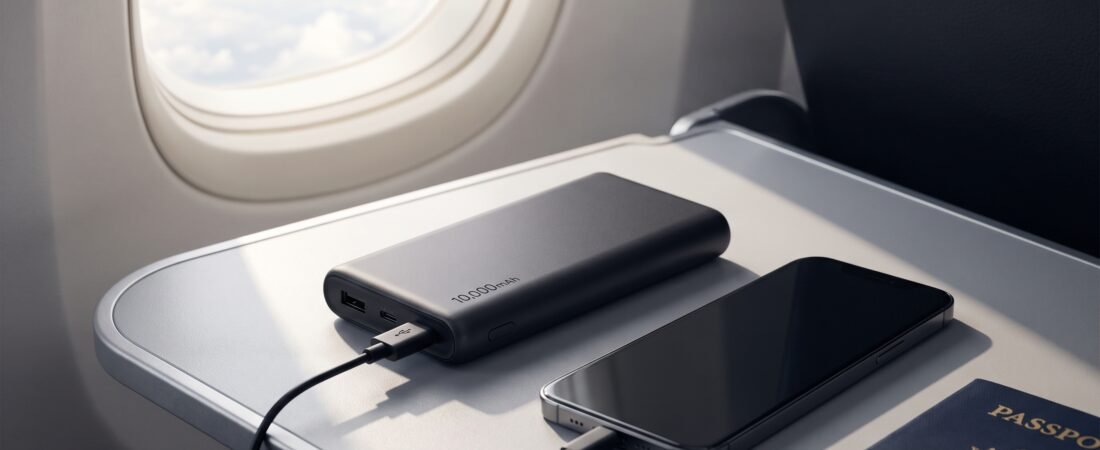
Planning to bring a power bank on a plane? For many US trips, a clearly labeled power bank rated at 100 watt-hours (Wh) or less is the simplest starting point. Pack it in your carry-on, protect it from damage and check the current rules of every operating airline. Capacity is only part of the decision: airlines may also limit the number of power banks, where you store them and whether you use them during the flight.
A power bank contains a spare lithium-ion battery. Under US FAA rules, power banks must be carried in the cabin, not checked baggage. International rules and individual airline policies may impose additional restrictions. ICAO’s 2026 guidance includes a maximum of two power banks per passenger and prohibits recharging power banks onboard. Airline rules can be stricter than the general FAA baseline.
Review note: Airline and safety rules can change. This guide does not claim a fresh review date; confirm the linked official policies before departure.
Can You Bring a Power Bank on a Plane?
- Up to 100Wh: Generally allowed under FAA rules when carried in the cabin, subject to airline restrictions.
- Above 100Wh and up to 160Wh: FAA rules generally require airline approval for larger spare lithium-ion batteries. A carrier may still refuse a power bank under its own policy.
- Above 160Wh: Not allowed on ordinary passenger aircraft under the standard rules for lithium-ion batteries.
- Carry-on only: Power banks cannot go in checked baggage. If your carry-on is gate-checked, remove the power bank and keep it with you in the cabin.
- Quantity: FAA rules limit larger 101–160Wh spare batteries to two per person with approval. ICAO’s 2026 power-bank guidance sets a maximum of two power banks per passenger; individual airlines may be stricter.
- During the flight: ICAO’s 2026 guidance prohibits recharging a power bank onboard and recommends against using one to recharge another portable electronic device. Some airlines impose a stricter ban on device charging.
Official source: FAA — Airline Passengers and Batteries.
Power Banks Worth Considering for Travel
Anker Nano A1259
A 10,000mAh-class power bank with a built-in USB-C cable and manufacturer-listed 30W output. Designed for compatible phones and smaller devices.
CUKTECH 10 PB100P
A 10,000mAh-class option with a display. Confirm the exact model variant and port-by-port output before buying.
UGREEN Nexode 145W
A 25,000mAh model listed by the manufacturer at 90Wh. It offers higher output but weighs more than compact phone-focused models.
These are research-based options, not a hands-on test ranking. Confirm the exact retailer listing, current specifications, recall status and airline policy before purchase or travel.
The Power-Bank Rules That Matter
1. Keep your power bank in the cabin
The FAA treats a power bank as a spare lithium battery. Spare lithium batteries and portable chargers must travel in carry-on baggage, not checked baggage. If your carry-on is taken at the gate and sent to the cargo hold, remove the power bank first and keep it with you in the cabin.
Protect the battery from damage and short circuits. A small pouch can keep it separate from keys, coins and other metal objects. Avoid packing a loose power bank where its ports or terminals could be damaged or touch conductive objects.
2. Check the Wh rating on the actual device
Watt-hours (Wh) measure the energy stored in a battery. Under FAA passenger-baggage rules, spare lithium-ion batteries rated at up to 100Wh are generally allowed. Batteries above 100Wh and up to 160Wh generally require airline approval; batteries above 160Wh are not allowed under the standard passenger-aircraft rules.
Power banks are also subject to power-bank-specific restrictions under ICAO’s 2026 guidance. That guidance limits passengers to no more than two power banks and prohibits recharging power banks onboard. ICAO recommends against using a power bank to recharge another portable electronic device during a flight. Individual airlines may apply stricter limits, including a 100Wh maximum.
3. Follow the operating airline’s policy
Airlines can set stricter limits on the number of power banks, maximum capacity, storage location and onboard use. For example, American Airlines limits portable chargers to two per passenger, each no more than 100Wh. Delta also limits power banks to two per passenger, with each no more than 100Wh, and prohibits recharging a power bank onboard or using one to charge another device during taxi, takeoff and landing.
Southwest’s published policy limits each customer to one power bank rated at no more than 100Wh. It must remain accessible and cannot be stored in an overhead bin. Check the current policy directly before travel, since carrier rules can change.
Check each operating airline on your itinerary, including partner airlines on connecting flights. A rule published by one US carrier does not automatically apply to another carrier or to a flight departing another country.
4. Do not travel with a damaged or recalled battery
Swelling, cracks, leakage, unusual heat, smoke or an unusual odor are warning signs. Stop using a power bank that appears damaged. The FAA says damaged or recalled batteries that could create sparks or dangerous heat must not be carried aboard unless the battery has been removed or otherwise made safe under the applicable instructions.
If a battery starts smoking, swelling or overheating during a flight, notify the cabin crew immediately. Do not put it away and hope the problem disappears.
Reference: FAA PackSafe passenger guidance.
How to Calculate Watt-Hours
Many power banks display their watt-hour rating on the case. If the Wh rating is not shown, you can calculate an estimate using the battery’s capacity and voltage:
Example: 10,000mAh × 3.7V ÷ 1,000 = 37Wh.
| Advertised capacity | Approx. energy at 3.7V | Typical use |
|---|---|---|
| 5,000mAh | 18.5Wh | Emergency phone top-ups |
| 10,000mAh | 37Wh | Everyday phone charging |
| 20,000mAh | 74Wh | Phones and tablets |
| 25,000mAh | 92.5Wh | Higher-capacity travel charging |
| 27,000mAh | 99.9Wh | Very close to the 100Wh threshold |
These figures are examples calculated at an assumed 3.7V. A 25,000mAh battery rated at 3.6V equals 90Wh. The actual Wh marking and manufacturer documentation for your exact power bank take priority over this illustrative table.
If the label is missing, unreadable or inconsistent with the product page, contact the manufacturer and airline before travelling. Do not rely only on the advertised mAh number, especially if the battery may be close to a capacity limit.
US Airline Rules at a Glance
The table below summarizes published policies and the general FAA baseline. It is not a guarantee that a power bank will be accepted on every itinerary. Check the linked official airline pages again before departure.
| Airline / authority | Published power-bank rule | What to do |
|---|---|---|
| FAA baseline | Power banks must be carried in the cabin. Spare lithium-ion batteries up to 100Wh are generally allowed; 101–160Wh batteries require airline approval and are subject to quantity limits. Airlines may impose stricter power-bank limits. | Check the exact Wh label and the operating airline’s policy. |
| American Airlines | Maximum two portable chargers per passenger onboard, each no more than 100Wh. They must remain accessible and visible when in use. Do not use in-seat power to recharge a portable charger. | Keep the bank within reach and check the current restricted-items page. |
| Southwest Airlines | Published policy limits each customer to one power bank rated at no more than 100Wh. It must remain accessible, not be stored in the overhead bin, and must be visible when in use. Do not recharge it onboard. | Keep it accessible, such as in a personal item under the seat, and follow crew instructions. |
| Delta Air Lines | Maximum two power banks per person, each no more than 100Wh. They must remain accessible, not be stored in an overhead bin, and must not be recharged onboard or used to recharge another device during taxi, takeoff or landing. | Check Delta’s current battery-powered-items page before travel. |
| Other airlines | Quantity, capacity, storage and onboard-use policies may differ by carrier and departure country. | Check every operating airline’s official page rather than assuming the same rules apply everywhere. |
These are policy summaries, not a substitute for the airline’s current rules. If the airline’s policy differs from this summary, follow the live official policy.
- FAA — Airline Passengers and Batteries
- American Airlines — Restricted items
- Southwest Airlines — Lithium batteries and power banks
- Delta Air Lines — Battery or fuel-powered items
Important: FAA guidance and airline policies are not interchangeable. Even where the general rules provide an approval route for some larger spare lithium batteries, an airline may refuse a power bank that exceeds its own capacity limit.
Can You Use a Power Bank During a Flight?
Carrying a power bank and using it onboard are separate questions. ICAO’s 2026 guidance prohibits recharging power banks onboard, limits each passenger to no more than two power banks and recommends against using a power bank to recharge another portable electronic device during a flight.
The recommendation against charging another device is not, by itself, a universal prohibition in every situation. However, individual airlines can impose stricter rules. Delta, for example, prohibits using a power bank to charge another device during taxi, takeoff and landing and prohibits onboard recharging of the power bank itself. American Airlines and Southwest also publish restrictions on recharging power banks onboard.
- Do not recharge the power bank itself from an aircraft USB port or AC outlet.
- Keep it accessible. Some airlines prohibit overhead-bin storage and require the power bank to be visible when in use.
- Do not assume device charging is allowed. Check the operating airline’s policy before using a power bank to charge a phone or tablet.
- Follow crew instructions. Stop using or stow a device when instructed.
- Check international connections. Rules in the departure country and the operating airline may be stricter than the FAA baseline.
Official references: ICAO — Addendum No. 1 to the 2025–2026 Technical Instructions and IATA — Guidance on power-bank changes.
How to Check a Power Bank for Recalls
A familiar brand name does not establish that every model is safe. Recalls can affect specific model numbers or serial-number ranges, so check the exact device you own or plan to purchase.
In 2025, the US Consumer Product Safety Commission announced two significant Anker power-bank recalls:
- June 12, 2025: Approximately 1,158,000 Anker PowerCore 10000 units, model A1263, were recalled because of fire and burn hazards.
- September 18, 2025: Approximately 481,000 Anker power banks, models A1647, A1652, A1257, A1681 and A1689, were recalled because of fire and burn hazards.
These are examples, not a complete list of every battery recall. Check the latest CPSC notices and the manufacturer’s recall information.
Your recall checklist
- Find the model number. Look at the back, bottom or side of the power bank.
- Search the CPSC website. Compare the exact model and any affected serial-number range.
- Check the manufacturer. Use the official recall page or serial-number checker if available.
- Stop using a recalled product. Follow the official refund, replacement or other remedy instructions.
- Arrange safe disposal. Contact your local household hazardous-waste facility for instructions. Do not put a recalled lithium-ion battery in household trash or a regular recycling bin.
If your power bank is swollen, cracked, leaking or unusually hot, stop using it even if you cannot find a matching recall notice. Do not pack a suspect battery in your luggage.
Three Power Banks for Different Travel Needs
The best travel power bank is not automatically the biggest or the one with the highest advertised output. For most people, a clearly labeled battery, suitable capacity, compatible charging output and manageable weight matter more than a headline number.
The three options below serve different needs: everyday phone charging, compact fast charging and higher-output charging for compatible laptops or tablets. We did not personally test these products, so the comparison is based on available manufacturer information and intended use cases rather than hands-on performance results.
1. Anker Nano Power Bank — 30W, Built-In USB-C Cable
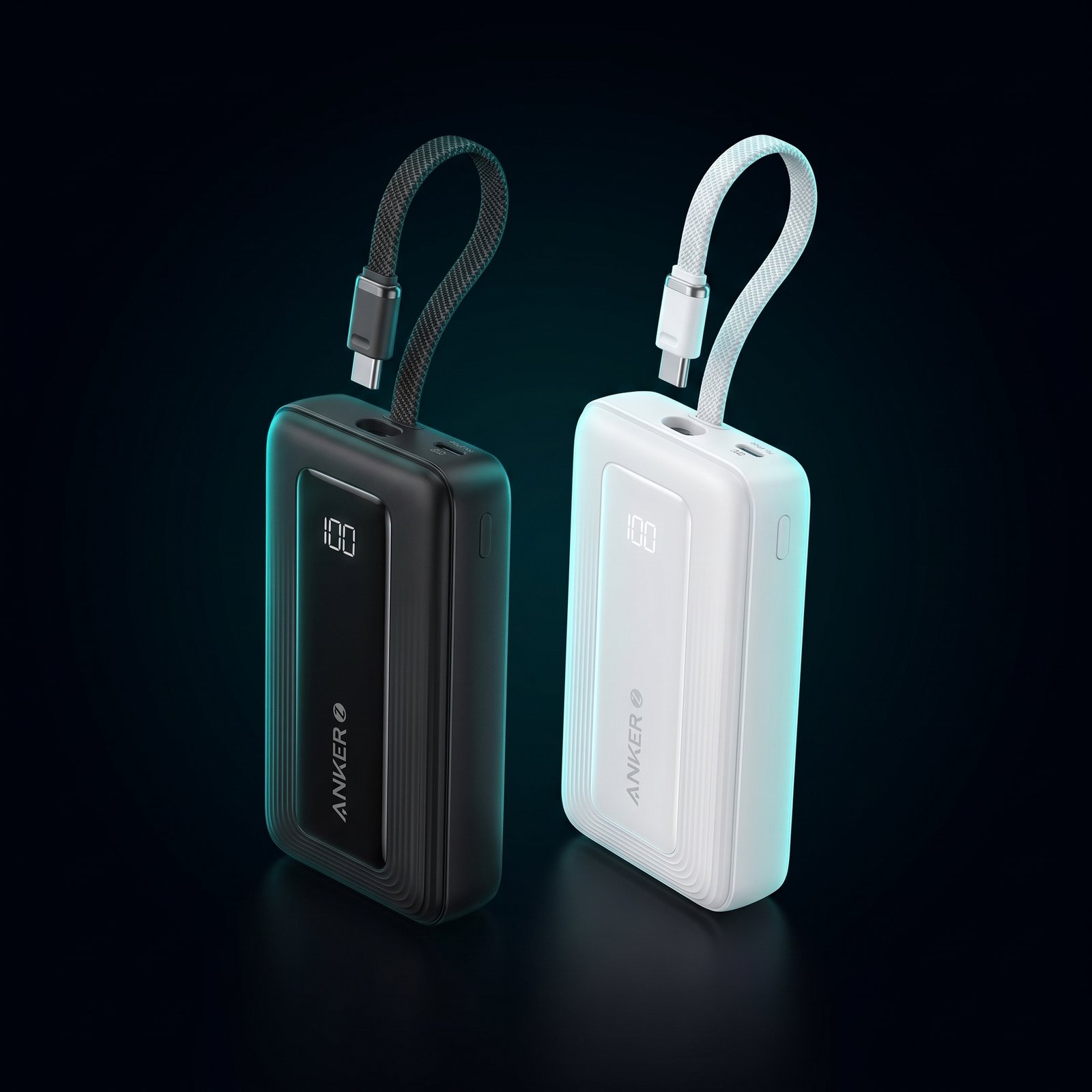
Anker’s manufacturer documentation identifies the Nano Power Bank model A1259 as a compact power bank with a built-in USB-C cable and up to 30W output. Available manufacturer information lists dimensions of approximately 104 × 52.3 × 26mm and a weight of about 215g.
Its main convenience is the built-in charging cable, which reduces the number of separate accessories you need to remember. For someone who mainly charges a compatible phone, that may be more useful than carrying a heavier high-capacity model.
What we like
- Built-in USB-C cable can reduce cable clutter.
- Manufacturer-listed output of up to 30W suits many compatible phones and smaller devices.
- The 10,000mAh class offers a practical balance of capacity and portability.
What to consider
- It is not the first choice for demanding laptop charging.
- Actual charging speed depends on the connected device and supported charging protocol.
- Confirm the exact model number and recall status before purchase.
Who should consider it: Travelers who mainly charge a phone and prefer a built-in cable.
Who should skip it: People who need high-output laptop charging or prioritize maximum battery capacity over compact size.
Model: Anker Nano A1259
Advertised capacity: 10,000mAh class
Output: Up to 30W, according to manufacturer information
Dimensions: Approximately 104 × 52.3 × 26mm
Weight: Approximately 215g
Air-travel note: Confirm the exact Wh rating printed on the device and check the airline’s current policy.
Manufacturer information reviewed; exact retailer variant should be confirmed.
If you use an iPhone and prefer a magnetic phone-back option, see our guide to slim MagSafe power banks. As with any battery, check the exact model, printed Wh rating and airline policy before travelling.
2. CUKTECH 10 Power Bank — Model PB100P
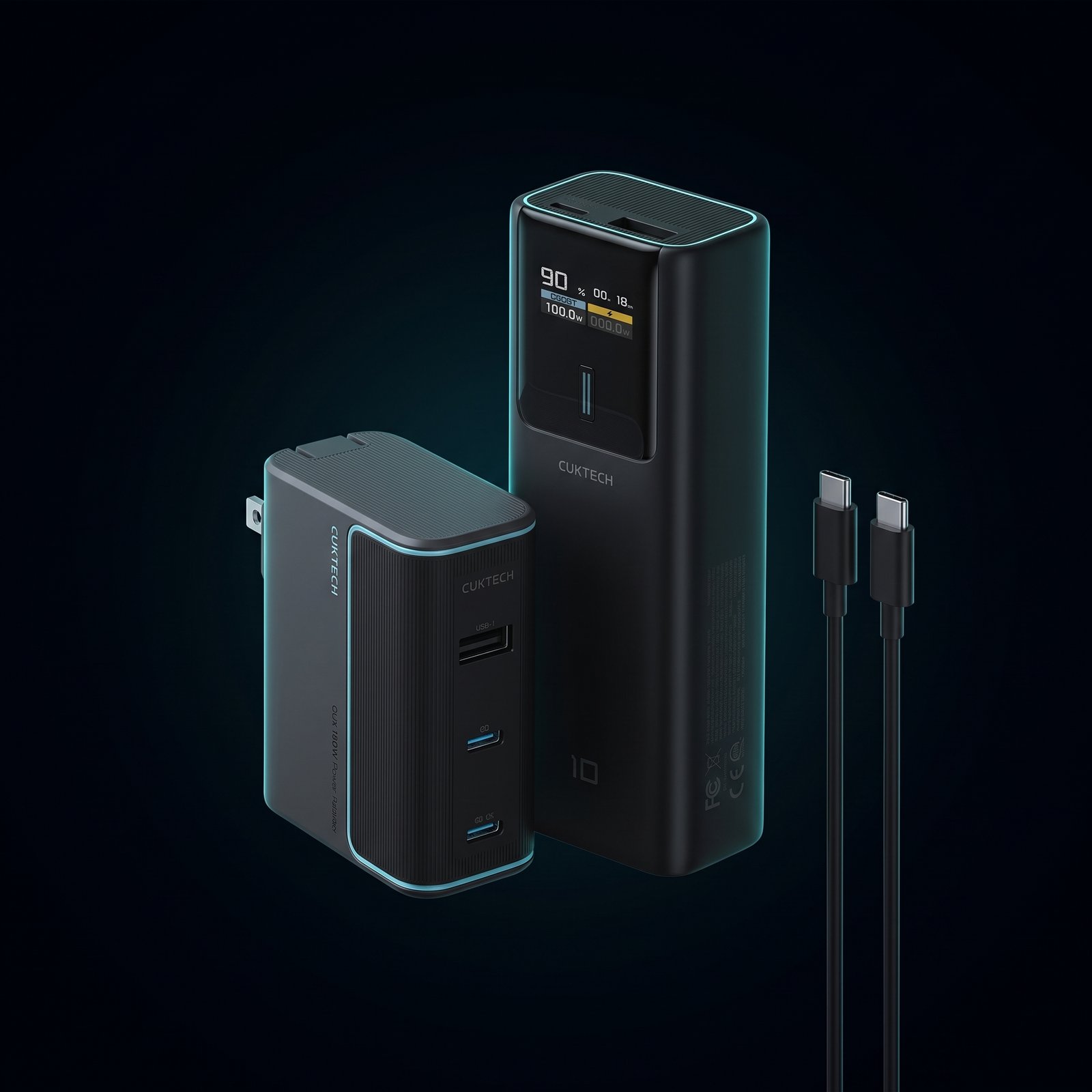
CUKTECH’s official product page identifies the CUKTECH 10 as model PB100P. The manufacturer describes a 10,000mAh-class battery, a display and fast-charging features. Its compact capacity may suit someone who wants a travel-friendly battery without moving up to a heavier 20,000–25,000mAh model.
The exact maximum output needs careful verification: product marketing, detailed port specifications and retailer bundles may describe different power ratings. A bundled USB-C wall charger can have a different wattage from the power bank itself. Check the exact variant and port-by-port output on the current manufacturer page and retailer listing rather than assuming a bundle’s headline number applies to the battery.
What we like
- The 10,000mAh class is relatively easy to carry.
- A display can help show battery or charging status.
- Fast charging can be useful when the connected device supports the relevant protocol.
What to consider
- Maximum output depends on the port and charging configuration.
- Retail bundles may include a separate wall charger with a different power rating.
- The exact retailer variant and printed Wh label need to match the product being purchased.
Who should consider it: Travelers who want a compact power bank with a display and fast-charging features.
Who should skip it: Buyers who cannot confirm the exact model and output specifications, or who need a power bank verified for high-wattage laptop charging.
Model: CUKTECH 10 PB100P
Advertised capacity: 10,000mAh class
Features: Display and fast-charging features, according to manufacturer information
Output: Verify the exact port-by-port ratings for the selected variant; no single maximum-output figure is asserted here.
Air-travel note: Check the Wh marking and airline restrictions before departure.
Manufacturer information reviewed; verify the selected variant’s output before purchase.
3. UGREEN Nexode Power Bank — 145W, 25,000mAh
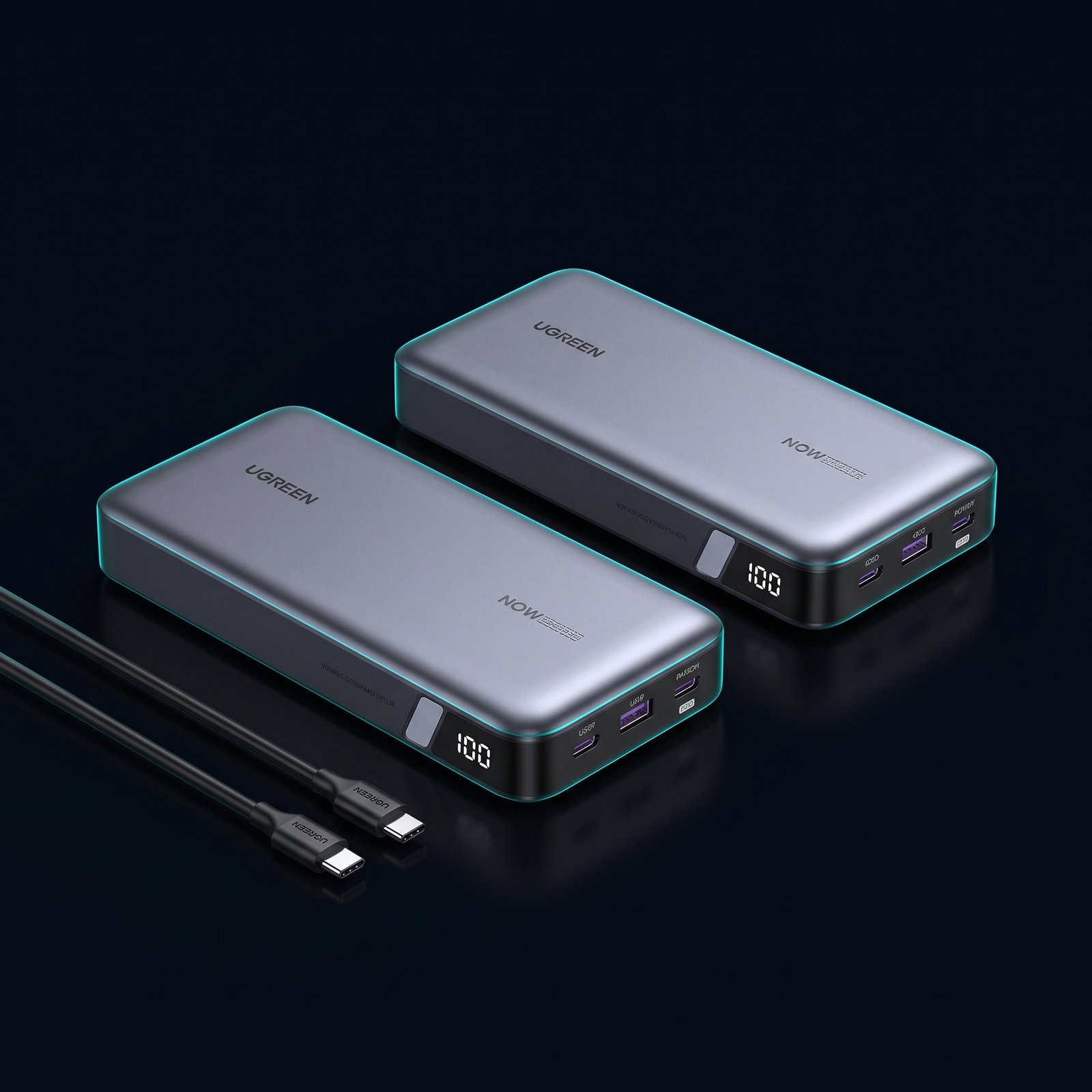
UGREEN’s manufacturer information lists a Nexode 145W power bank with 25,000mAh capacity and a 90Wh energy rating. Published specifications describe up to 140W from one USB-C port, up to 65W from the second USB-C port, up to 22.5W from USB-A and a combined maximum output of 145W.
The listed 90Wh rating is below the FAA’s general 100Wh threshold. However, the physical size and weight make this a different travel choice from a pocket-sized phone charger. At approximately 513g, it is more suited to someone who regularly carries a compatible laptop or tablet than to someone who only wants an emergency phone top-up.
What we like
- Manufacturer-listed energy rating of 90Wh is below 100Wh.
- High-output USB-C charging can suit compatible laptops and tablets.
- Multiple ports can provide flexibility for compatible devices.
What to consider
- At approximately 513g, it is heavier than a compact 10,000mAh model.
- Maximum output depends on device compatibility and port configuration.
- Similar product names can refer to different models, so verify the exact retailer listing.
Who should consider it: Travelers who regularly charge a compatible laptop or tablet and value higher capacity over minimum weight.
Who should skip it: People who only need emergency phone charging, want a lightweight everyday-carry item or do not need high USB-C output.
Advertised capacity: 25,000mAh
Rated energy: 90Wh, according to manufacturer information
Published port output: Up to 140W USB-C1, up to 65W USB-C2 and up to 22.5W USB-A
Combined maximum output: 145W
Published weight: Approximately 513g
Air-travel note: Confirm the exact model and Wh marking on the device, then check the operating airline’s current restrictions.
Manufacturer information reviewed; confirm the exact retailer model before purchase.
Which Power Bank Should You Carry?
- For everyday phone charging: Start with a 10,000mAh-class model. It may be enough without adding unnecessary weight to your bag.
- For fewer cables: Consider a power bank with a built-in cable if it supports your phone and suits your everyday use.
- For a laptop or tablet: Check the USB-C output your device needs and whether the power bank supports the appropriate charging protocol. Capacity alone does not guarantee laptop compatibility.
- For longer trips: A 20,000–25,000mAh model may store more energy, but check its exact Wh rating, weight and airline restrictions.
- For strict airline policies: Prioritize a clearly labeled model within the airline’s capacity limit and follow its quantity and storage rules.
You may not need to buy another power bank at all. If your current one is undamaged, not recalled, clearly labeled and accepted under your airline’s current rules, it may already meet your needs.
What Not to Bring or Do
- A power bank packed in checked baggage.
- A swollen, cracked, leaking or unusually hot battery.
- A recalled or defective model that has not been made safe under official instructions.
- A battery with an unreadable Wh rating when its capacity cannot be confirmed.
- More power banks than the operating airline permits.
- A power bank stored in an overhead bin when the airline prohibits it.
- A plan to recharge the power bank using an aircraft outlet during the flight.
- The assumption that all US and international airlines have identical power-bank rules.
If you are unsure whether your battery qualifies, contact the airline before travelling. Confirming the rule in advance is better than discovering a problem at check-in or boarding.
Frequently Asked Questions
Can I bring a 20,000mAh power bank on a plane?
Usually, if its actual Wh rating and the operating airline’s rules allow it. At 3.7V, 20,000mAh is approximately 74Wh. Check the rating printed on your specific power bank and confirm the airline’s current policy.
Can I put a power bank in checked luggage?
No. FAA guidance requires spare lithium batteries, including power banks, to be carried in the cabin rather than checked baggage. If your carry-on is gate-checked, remove the power bank and keep it with you.
Can I bring two power banks on a US flight?
It depends on the airline. ICAO’s 2026 guidance limits passengers to no more than two power banks, but individual carriers can be stricter. Southwest, for example, publishes a one-power-bank limit. Check each operating airline’s current policy.
Can I charge my phone with a power bank during a flight?
Do not assume it is permitted. ICAO recommends against using power banks to recharge portable electronic devices onboard, and individual airlines may impose stricter rules. Delta prohibits using a power bank to charge another device during taxi, takeoff and landing. Check the operating airline’s current policy and follow crew instructions.
What if my power bank has no Wh label?
Contact the manufacturer for documentation and ask the airline before travelling. Do not rely only on the advertised mAh figure, especially if the battery may be close to a capacity limit.
Final Verdict: Check the Battery Before You Pack
For many travelers, a clearly labeled, undamaged power bank rated at 100Wh or less is the simplest option. A compact 10,000mAh-class model can be enough for everyday phone charging, while laptop users may prefer a higher-output model if it is compatible with their device and accepted by the airline.
Before packing, verify three things: the exact Wh rating, the operating airline’s current power-bank policy and the model’s recall status. Power banks must stay in the cabin. ICAO’s 2026 guidance prohibits recharging power banks onboard, and individual airlines can impose stricter conditions on using them to charge other devices.
You do not need to buy a new power bank just because you are travelling. Check the one you already own first; if it is safe, properly labeled and accepted by your airline, it may be all you need.
Check the Anker Nano listing on Amazon →Sources and Editorial Notes
This guide references official FAA battery guidance, published airline policies, ICAO and IATA power-bank guidance, CPSC recall notices and manufacturer product information. Rules and product specifications can change. Use the linked primary sources to verify details before travelling or purchasing.
- FAA — Airline Passengers and Batteries
- FAA — PackSafe for Passengers
- American Airlines — Restricted items
- Southwest Airlines — Lithium batteries and power banks
- Delta Air Lines — Battery or fuel-powered items
- ICAO — Addendum No. 1 to the 2025–2026 Technical Instructions
- ICAO — New power-bank restrictions
- IATA — Guidance on power-bank changes
- CPSC — Anker PowerCore 10000, model A1263 recall
- CPSC — Anker power-bank recall, September 2025
- Anker — Nano Power Bank manufacturer documentation
- CUKTECH — CUKTECH 10 manufacturer page
- UGREEN — Nexode 145W manufacturer page
Editorial note: The Few Picks did not personally test the products in this guide. Product comparisons are based on available manufacturer information and practical use cases. The exact Amazon model match, live price, availability and recall status should be confirmed before purchase. Airline policies can change, so readers should check the current rules before departure.